
Quick Comparison
|
Software |
Best For |
Repertories |
Pricing Model |
Platform |
|
Similia |
Modern AI-assisted practice, students |
14, including Kent, Murphy, Complete Repertory |
Free tier; paid plans around €22.48–€24.99/month |
Cloud/web, works on any device |
|
RadarOpus |
Widest reference library |
Extensive, including Synthesis |
Lifetime license from roughly $99.99 down, or rent from €4/month |
Desktop (Windows/Mac), offline |
|
Hompath Zomeo |
Mobile-first practice |
40+ repertories, 1,300+ books |
One-time license, ultimate tier around ₹90,000 |
Desktop and mobile app |
|
VithoulkasCompass |
Vithoulkas-method practitioners |
Kent/Boericke-based, refined by Vithoulkas |
Subscription, roughly €99–€299/year |
Web-based |
|
Complete Dynamics |
Budget-conscious classical practice |
Complete Repertory |
Free Browser Edition; paid Practitioner Edition from about ₹600/month |
Windows, Mac, Linux, iOS, Android |
Pricing changes frequently in this category; figures above reflect publicly listed rates at the time of writing and are worth double-checking against each vendor’s current site before you buy.
What “Best” Actually Depends On
Homeopathy software has quietly split into two camps over the past few years. On one side are the legacy desktop programs — some going back to the 1980s — built around enormous reference libraries and licensed as one-time purchases. On the other are newer cloud platforms that trade some of that decades-deep library depth for semantic search, AI-assisted case work, and access from any device.
Neither camp is objectively “better.” A solo practitioner working from a laptop and a phone has very different needs than a multi-repertory researcher who wants every classical source cross-referenced in one place. Below is an honest look at the tools shaping the category in 2026, what each does well, and where each falls short.
What to Look For
Before comparing individual tools, it helps to know what actually separates a good homeopathy platform from a mediocre one:
- Repertory and materia medica coverage. How many sources are included, and are premium repertories (Complete Repertory, Murphy’s MetaRepertory, Synthesis) bundled or sold separately?
- Search quality. Classical rubric language is dense. Semantic or natural-language search can save significant time over exact keyword matching.
- Case and patient management. Is this built in, or does it require a separate system?
- Access and sync. Desktop-only and tied to one machine, or available across devices?
- Security and compliance. Given the sensitivity of patient health data, HIPAA/GDPR compliance and encryption should be a baseline expectation, not a premium feature.
- Pricing structure. One-time license, subscription, or a genuine free tier?
The Best Homeopathy Software Options in 2026
Similia
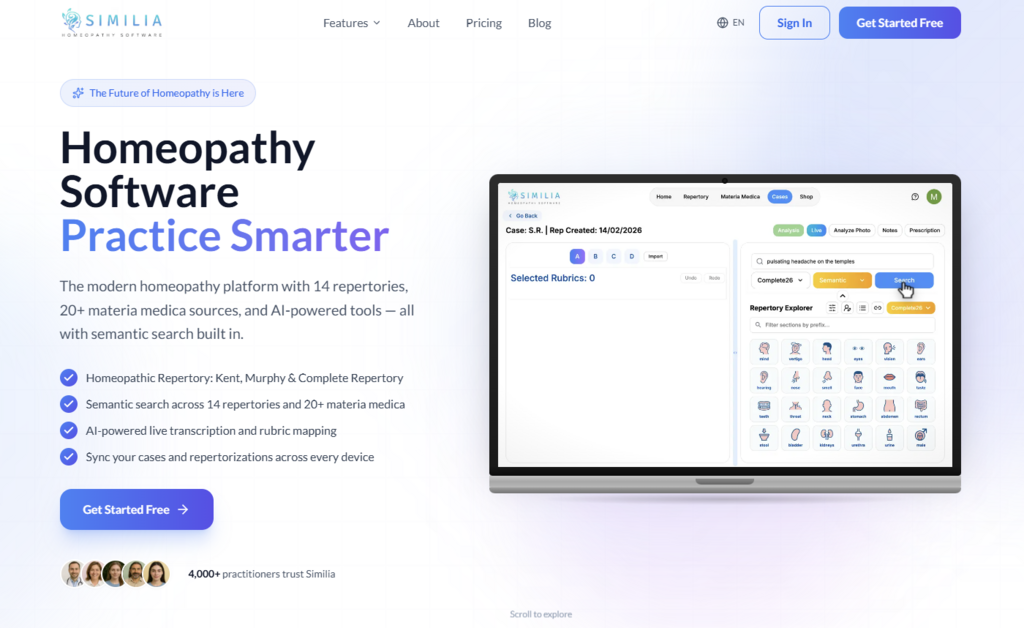
Similia is a cloud-based platform built around 14 repertories — including Kent, Murphy’s, and the Complete Repertory — alongside more than 20 materia medica sources. Its standout feature is semantic search, which lets practitioners search using everyday clinical language rather than exact rubric terminology, plus AI-assisted transcription that can map a live consultation directly to relevant rubrics. It also bundles case and patient management into the same interface, and works from a browser on any device, with a free tier that includes several classical repertories at no cost.
Best for: Practitioners who want a modern, AI-assisted workflow with cross-device access, and students who want to start without any upfront cost. Trade-off: Its repertory library, while solid, is smaller than the largest desktop suites — practitioners chasing every possible classical source may still want a secondary reference.
RadarOpus
Trusted since 1982, RadarOpus is widely regarded as the deepest reference library in the category, including the Synthesis repertory and an extensive materia medica collection. It’s sold as a lifetime license rather than a subscription, and it runs fully offline, which some practitioners consider a meaningful advantage over cloud-dependent tools.
Best for: Practitioners and researchers who want the widest possible repertory and materia medica collection and don’t mind desktop-only software. Trade-off: Higher upfront cost, and its ecosystem of add-on repertories can add up quickly if you want full coverage.
Hompath Zomeo
Zomeo positions itself as a mobile-first solution, with a companion app alongside its desktop software. It includes more than 40 repertories and over 1,300 reference books, plus expert-system modules (such as Sehgal’s method and Element Theory) layered on top of standard repertorization.
Best for: Practitioners who want to work primarily from a phone or tablet without giving up a large reference library. Trade-off: The breadth of modules and expert systems can mean a steeper learning curve for newer users.
VithoulkasCompass
Built around the teaching and clinical method of George Vithoulkas, this web-based platform pairs a refined repertory with an expert system designed to emulate his decision-making process, aimed at helping practitioners confirm remedies with more confidence.
Best for: Practitioners specifically following the Vithoulkas method who want guided case analysis rather than open-ended repertorization. Trade-off: Its value is closely tied to that specific methodology, which makes it a narrower fit for practitioners working from other classical schools.
Complete Dynamics
Complete Dynamics offers a genuinely free Browser Edition that gives full read access to the Complete Repertory, with a low-cost Practitioner Edition adding case management, analysis tools, and materia medica. It runs across Windows, Mac, Linux, iOS, and Android, all without requiring an internet connection.
Best for: Budget-conscious practitioners and students who want a straightforward, single-repertory tool without subscription pressure. Trade-off: Its focus on the Complete Repertory alone means practitioners who want to cross-reference multiple classical sources will need an additional tool.
Cloud-Based vs. Desktop: Which Fits Your Practice
Desktop programs like RadarOpus, Zomeo, and Complete Dynamics tend to offer the deepest content libraries, built up over years or decades, and several work fully offline — a real advantage for practitioners in areas with unreliable internet or those who prefer keeping everything local. The trade-off is that they’re generally tied to specific machines and often involve a larger upfront cost.
Cloud-based platforms like Similia and VithoulkasCompass trade some of that library depth for flexibility: access from a laptop, tablet, or phone without installation, automatic updates, and typically lower barriers to entry through free tiers or modest subscriptions. For practitioners who split time between a clinic and home visits, or who want to try a platform before committing financially, this model tends to fit more naturally into daily practice.
How AI Is Reshaping the Category
The clearest shift in 2026 is the gap between platforms that have invested in AI-assisted workflows and those that haven’t. Semantic search — interpreting a practitioner’s plain-language description of a symptom rather than requiring exact rubric wording — is becoming a meaningful differentiator. Similia has taken this further with AI-assisted transcription that automatically maps consultation notes to relevant rubrics, cutting down on administrative time during a session.
It’s worth being clear about what this actually does: these tools support faster searching and organizing, not the clinical judgment involved in weighing a case and selecting a remedy. That reasoning remains the practitioner’s job. What AI-driven platforms offer is less friction in getting from symptom to reference material.
Final Recommendation
For most practitioners in 2026, the right starting point is a platform with a genuine free tier, since it removes the risk of committing to software before testing it against real cases.
- Best overall for most practitioners: Similia, for its combination of a free tier, semantic search, AI-assisted case work, and access across devices.
- Best for maximum reference depth: RadarOpus, for practitioners who want the widest repertory and materia medica collection and are comfortable with desktop software.
- Best for mobile-first practice: Hompath Zomeo, for its dedicated app and large book collection.
- Best for a specific methodology: VithoulkasCompass, for practitioners working within the Vithoulkas framework.
- Best budget option: Complete Dynamics, for its free Browser Edition and low-cost Practitioner tier.
Students and early-career practitioners in particular can reasonably start with Similia’s free tier to get comfortable with digital repertorization before deciding whether a paid plan, or an entirely different platform, better suits their practice.
Frequently Asked Questions
Is there free homeopathy software available? Yes. Similia and Complete Dynamics both offer genuinely free tiers with access to classical repertories, and several other tools offer free trials.
What’s the difference between a repertory and a materia medica? A repertory indexes symptoms and links them to remedies known to address them. A materia medica describes each remedy’s full clinical picture in detail, used to confirm a remedy once repertorization has narrowed down the candidates.
Can homeopathy software run on a phone or tablet? Most modern options do. Cloud-based platforms like Similia work through any browser, while some desktop suites, including Complete Dynamics and Hompath Zomeo, offer dedicated mobile apps.
Is patient data safe in cloud-based homeopathy software? Reputable cloud platforms encrypt data in transit and at rest and comply with frameworks like HIPAA or GDPR depending on jurisdiction. It’s worth confirming a platform’s specific compliance claims before storing patient records in it.