
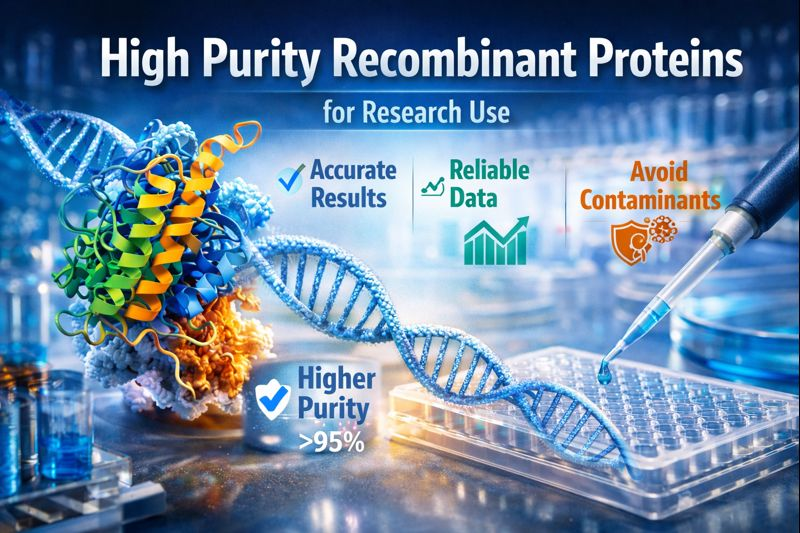
If you’re working in a lab and need reliable tools for your experiments, high purity recombinant proteins can make a big difference. These proteins are made through genetic methods, offering clean and consistent options for studies. They help avoid issues from impure sources that might skew results.
Many researchers turn to high purity recombinant proteins because they fit well in various tests. From checking cell functions to developing new drugs, these proteins provide the quality needed for accurate data. Plus, they’re designed for research use, so you get what works best in scientific settings.
In this post, we’ll look at why these proteins matter and how they can boost your work. We’ll cover their production, uses, and tips for picking the right ones. By the end, you’ll see how high purity recombinant proteins can support your projects.
What Are Recombinant Proteins?
Recombinant proteins come from combining DNA from different sources to create specific molecules. Scientists insert genes into host cells like bacteria or yeast to produce them. This process allows for large amounts of proteins that mimic natural ones.
These proteins are key in labs because they can be modified for certain needs. For example, adding tags helps with easy detection in experiments. Researchers use them to study diseases or test new treatments.
High purity recombinant proteins stand out due to their clean makeup. They go through steps to remove extras like host cell parts. This ensures the protein is mostly what you want, with little else mixed in.
Why Purity Levels Matter?
Purity in proteins affects how well experiments turn out. Low purity can introduce errors, like unwanted reactions from contaminants. High purity means clearer results and less time fixing problems.
In research, even small impurities can change outcomes. Think about enzyme studies where extra bits might block activity. Using high purity recombinant proteins helps keep things precise.
Labs often check purity with methods like gel tests or chromatography. These show if the protein meets standards. For research use, aim for at least 95% purity to trust your findings.
- Contaminants can lead to false positives in assays.
- High purity reduces batch differences.
- It saves resources by avoiding repeat tests.
Common Applications in Labs
Recombinant proteins for research use show up in many fields. In biology, they’re used to explore cell signaling paths. Scientists might add them to cells to see reactions.
In drug discovery, these proteins act as targets for testing compounds. High purity recombinant proteins allow for better binding studies. This speeds up finding potential medicines.
They also help in vaccine development by mimicking virus parts. Researchers use them to train immune responses in models. Plus, in diagnostics, they detect antibodies in samples.
- Protein-protein interaction studies.
- Structural analysis with X-ray or NMR.
- Functional assays for enzyme kinetics.
Production Methods
Making high purity recombinant proteins starts with gene cloning. The desired DNA is placed into a vector and transferred to host cells. Bacteria like E. coli are common for simple proteins.
For complex ones, mammalian cells might be used. These hosts add natural modifications like sugar groups. The choice depends on the protein’s needs.
After growth, purification follows. Techniques like affinity columns grab the protein specifically. Multiple steps ensure high purity, removing impurities each time.
We focus on optimized systems to yield consistent results. This includes controlled conditions to boost expression levels. The goal is proteins ready for your research use.
Benefits for Your Work
Switching to high purity recombinant proteins brings several upsides. First, they offer reliability across experiments. You won’t worry about varying quality from different suppliers.
They also cut down on preparation time. With ready-to-use formats, you jump straight into testing. This is great for busy labs handling multiple projects.
Cost-wise, while initial prices might seem higher, they save money long-term. Fewer failed runs mean less waste. For research use, this efficiency matters.
- Improved data accuracy.
- Easier scaling for larger studies.
- Support for advanced techniques like cryo-EM.
Challenges and Solutions
One issue with recombinant proteins is expression levels. Some genes don’t produce well in certain hosts. Switching to different systems often fixes this.
Folding problems can occur, leading to inactive proteins. Chaperones or refolding methods help correct this. High purity steps also filter out misfolded ones.
Stability is another concern. Adding stabilizers or storing properly keeps them active. For research use, check supplier guidelines to maintain quality.
We tackle these by testing each batch thoroughly. This includes activity checks and purity scans. Our approach ensures you get dependable high purity recombinant proteins.
Choosing the Right Ones
When selecting recombinant proteins for research use, look at specifications. Purity percentage, concentration, and format are key. Match them to your experiment’s requirements.
Consider the source. Reputable makers provide detailed data sheets. These include validation info to confirm performance.
Price shouldn’t be the only factor. Quality impacts results more than cost. Read reviews or ask peers for recommendations.
- Check for endotoxin levels if using in cell cultures.
- Ensure compatibility with your assays.
- Opt for custom options if standard ones don’t fit.
Future Trends
The field of recombinant proteins is evolving fast. New hosts like insect cells are gaining popularity for complex structures. This expands options for research use.
Advances in purification tech, like automated systems, improve efficiency. They allow for even higher purity levels with less effort.
Gene editing tools like CRISPR are changing production. They enable precise modifications for better yields. High purity recombinant proteins will benefit from these.
Integration with AI for design is on the rise. This predicts stable proteins before making them. It shortens development time for lab tools.
Conclusion
High purity recombinant proteins play a vital role in modern research. They provide the clean, consistent materials needed for trustworthy results. Whether you’re studying basic biology or advancing therapies, these proteins support your goals.
By choosing quality options, you enhance your work’s impact. Recombinant proteins for research use continue to drive discoveries. Make them part of your toolkit for better outcomes.