

When you’re standing in the insole aisle, the options can feel overwhelming. Gel cushions, foam pads, heel cups, full-length inserts, all of them promising relief. But cushioning and support aren’t the same thing, and for a lot of people, the difference between those two words is the difference between feeling better and spending another $30 on something that stops working by noon.
Retailers like The Good Feet Store are built around that distinction. Rather than offering a one-size-fits-all insole, Good Feet specializes in arch supports, products designed to work with the structural mechanics of your foot rather than simply padding below it. Understanding what separates a true arch support from a standard insole can help you make a smarter decision the next time your feet need help.
Insoles and Arch Supports: Not the Same Thing
The terms get used interchangeably, but they aren’t the same product. Most over-the-counter insoles are primarily cushioning devices. They’re soft, they compress underfoot, and they make the inside of a shoe feel more comfortable in the short term. That cushioning can feel good for the first few hours. But cushioning alone doesn’t address what’s happening structurally when your foot hits the ground.
Arch supports, on the other hand, are designed to work with the mechanics of your foot. The arch isn’t just a passive structure; it acts as a shock absorber and a stabilizer for every step. When the arch isn’t getting adequate support, the load gets redistributed, and that can contribute to discomfort not just in the feet, but in the knees, hips, and lower back as well.
An arch support that actually functions holds the arch in position rather than simply padding below it. That’s a meaningful mechanical difference.
Why One-Size-Fits-All Doesn’t Really Apply Here
Walk into any big-box store and you’ll find rows of insoles, almost all of them sized by shoe size and little else. The logic seems reasonable until you consider that two people wearing the same shoe size can have completely different arch heights, foot widths, and gait patterns. A low arch needs different support geometry than a high arch. A flat foot places load differently than a neutral foot. Someone who overpronates, where the foot rolls inward with each step, has different structural needs than someone with a high, rigid arch.
Generic insoles can’t account for that range. They’re engineered to a middle point that works adequately for some people and not particularly well for many others. When the fit is off, you may not notice it immediately. But over hours of walking or standing, a support that doesn’t match your arch can shift load in ways that contribute to fatigue in the foot, ankle, and even up the chain into the knee and hip.
This is where generic insoles fall short in a way that cushioning can’t compensate for. They’re built for efficiency of production, not the specific person wearing them. That matters when you’re on your feet for hours, doing real-world activities that require your feet to work dynamically.
What Personalized Fitting Actually Changes
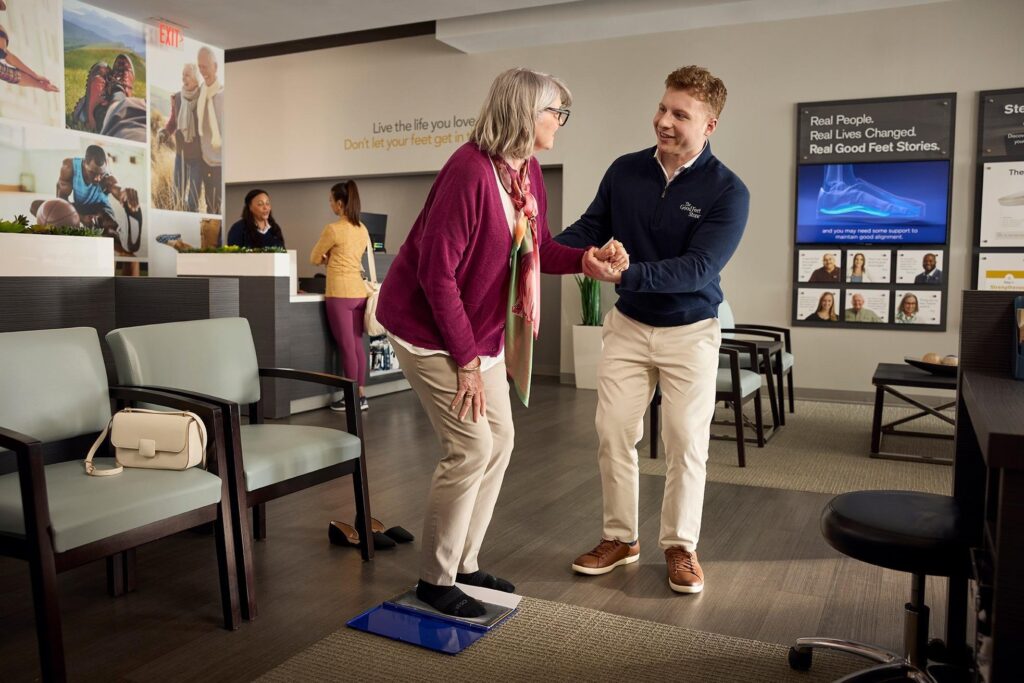
Rather than pulling a product off a shelf by shoe size, trained Good Feet associates work with customers to understand their individual arch structure and fit them to an arch support from a curated selection, with the goal of matching support to the actual shape and mechanics of that person’s foot.
That process changes the outcome in a practical way. When an arch support is fitted to your specific foot, it makes contact with the arch where it’s actually needed rather than where an average foot might need it. That contact is what allows the support to do its job: redistributing load, stabilizing the foot’s position, and reducing the compensation patterns that often lead to fatigue and discomfort over time.
The difference in outcome between a randomly selected insole and one fitted to your specific arch can be significant, particularly over time. Arch supports that match your foot’s structure help distribute weight more evenly, which may ease fatigue and may improve comfort during extended activity.
This isn’t about upselling a premium product. It’s about the fact that feet are individual, and the support system you put inside your shoes should reflect that.
The 3-Step System: Built for Long-Term Use, Not Quick Fixes
One element that sets Good Feet’s approach apart is the 3-Step System, which uses three types of arch supports for different functions throughout your day.
The Strengthener (Step 1) provides firm structural support and is designed for activity. The Maintainer (Step 2) is made for all-day wear during your normal daily routine. The Relaxer (Step 3) is a gentler support intended to give your feet recovery time between periods of higher-demand activity.
This tiered approach reflects how feet actually work: they’re not static, and the support they need shifts depending on activity level and recovery. A single insole worn all day, every day, doesn’t account for that variation.
Other Details Worth Knowing Before You Buy
A few practical points that can influence whether a foot support product actually works for you long-term:
Good Feet arch supports are made in the United States and come with a lifetime limited warranty, which is worth noting when evaluating long-term value against lower-cost alternatives. They’re also FSA and HSA eligible, so if you’re managing those funds before a year-end deadline, this is a qualifying purchase.
For anyone who’s been skeptical after previous insole disappointments, Good Feet also offers a 90-Day Customer Satisfaction Policy. There’s a minimum wear-in period required, which exists because it takes time to properly break in arch supports and experience their full effect. That’s a feature of the policy, not a catch.
If You’re Still Buying Insoles Off the Shelf, It Might Be Time to Ask a Different Question
The question isn’t whether you need more cushioning. For most people dealing with persistent foot fatigue or discomfort, the question is whether they’re getting any real structural support at all. Cushioning wears down. Arch support, when it’s fitted correctly, works with the foot’s mechanics in a way that may provide lasting relief rather than temporary softness underfoot.
If the insoles you’ve tried haven’t delivered, it’s worth considering whether you’ve been solving the right problem. A personalized arch support fitting may be a significantly different experience than anything you’ve picked up at the pharmacy.